Blue Whale Watching in Iceland
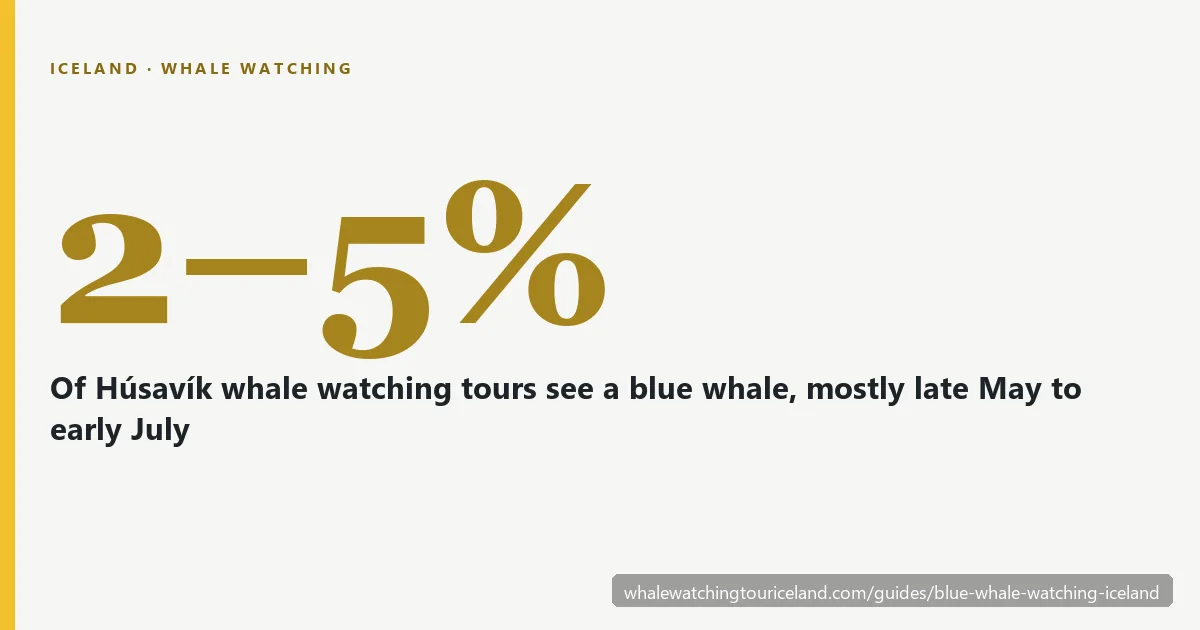
Blue whales are seen on about 2 to 5% of Húsavík tours, mostly May to early July. When to go, where, and what you will probably see instead.
You can see blue whales in Iceland, but only on a small share of trips. They turn up mainly in Skjálfandi Bay off Húsavík in North Iceland, on roughly 2 to 5% of tours, and mostly between May and early July, with late June the most likely time. In practice they are not seen from Reykjavík. If a blue whale is on your list, plan a June trip to Húsavík, book it for the humpbacks, minke whales and dolphins you are likely to see, and count a blue whale as luck.
Check Availability
The booking box above is for the Gentle Giants Big Whale Safari and Puffins speedboat tour from Húsavík, which runs from April to October. Below is what is known about the blue whale season, how often they appear, and which boat to choose.
Blue whale season in Iceland
Everyone agrees on early summer. Nobody agrees on the exact weeks, and none of the windows below comes from survey data.
| Source | Blue whale window |
|---|---|
| Visit Iceland (citing researchers) | Most likely in late June, sporadic through the summer |
| Húsavík whale-watching guide (isnet) | Late May to early July, June the most reliable |
| Guide to Iceland | Mid-June to mid-July |
| North Sailing (Húsavík operator) | Several blue whale days by mid-May in both 2024 and 2026 |
| Gentle Giants (Húsavík operator) | The season starts around the end of May |
Put together, the safest window is May to early July, aiming for the second half of June. North Sailing’s logs put blue whales in the bay from early May in 2024, when one fed off Flatey for over two weeks, and again by mid-May in 2026. A May trip is a real chance; a July or August one is less likely to find one.
Where to see blue whales in Iceland
Húsavík is the place. According to Visit Iceland, blue whales have only recently started appearing regularly within about two hours’ sailing of Húsavík, which it links to changes in the food web. Researchers have identified 148 individual blue whales in Skjálfandi Bay over ten years, which Visit Iceland puts at about 15% of the population in the region. The Húsavík Research Centre continues to photograph and log them.
Elsewhere they are a long shot:
- Eyjafjörður (Akureyri, Dalvík, Hauganes): the Dalvík operator mentions that blue whales are seen “sometimes”. Humpbacks are the reason to sail in the fjord.
- Snæfellsnes: Láki Tours in Ólafsvík reported a blue whale twice in 2026 and calls them occasional.
- Reykjavík and Faxaflói Bay: not a blue whale area in practice. The Reykjavík boats see humpbacks, minke whales, dolphins and porpoises.
Our Húsavík whale watching guide compares every company in town, and the Húsavík vs Akureyri guide helps if you are deciding where to base yourself in the north.
How likely is a blue whale?
Roughly one tour in 20 to one in 50 from Húsavík finds one. That figure comes from Húsavík operators, quoted by Visit Iceland, and it is far more useful than the labels on operator websites. Gentle Giants’ species page, for example, calls the blue whale “common” without giving a number.
Two things improve your chances a little:
- Go in June. May to early July is when the operators’ reports cluster.
- Give yourself more than one trip. Two nights in Húsavík in late June mean two chances, and a trip that finds nothing usually earns you a free return seat on the oak boats.
What does not help is paying for a “blue whale tour”. Every Húsavík trip sails the same bay, and no company can steer you to a blue whale.
Fin whales: the other giant
Fin whales, another of the big baleen whales, also turn up occasionally in Skjálfandi Bay, mostly from June to August, according to Gentle Giants and North Sailing. They are also the whale Iceland still hunts. Whaling resumed in 2026 after two years with no catch: the only whaling company took its first two fin whales on 21 and 22 June and ended the season on 20 September with 93 fin whales, out of a quota of 150. The government says it will put a bill for a permanent ban to parliament in February 2027. That is a plan, not a law yet.
What you are likely to see instead
On a June trip from Húsavík, this is what you are likely to see:
- Humpback whales: the most reliable large whale in summer, peaking from June to August.
- Minke whales: common from March to November.
- White-beaked dolphins: mainly in summer, peaking from June to August.
- Harbor porpoises: present year-round.
- Puffins: on Lundey (Puffin Island) from about mid-April to mid-August, on the speedboat and puffin tours.
Húsavík operators report whales on 97 to 99% of the tours that sail. Those are their own figures, not audited, but they explain why a trip without a blue whale still tends to be a good one.
Which boat gives you the best blue whale chance
There is no published evidence that one boat sees more blue whales than another, so choose the trip by comfort and budget.
The Gentle Giants Big Whale Safari and Puffins tour is a two-hour RIB speedboat trip for up to 12 passengers, from $176 per person and rated 4.7 from 1,530+ reviews (our review). It runs from 1 April to 31 October. From mid-April to mid-August it stops at Puffin Island first, weather permitting. Gentle Giants says the speedboat’s speed makes it more likely you will reach the bigger whales, because it covers more of the bay. A warm safety overall and a life jacket are included. Minimum age is 8 and minimum height 130 cm, and the tour is not allowed for passengers with heart or back problems or for pregnant women. If you see no whales or dolphins, you get a voucher for a traditional oak-boat tour, not a refund.
Some three-star reviews say the speedboat kept further back from the whales than the larger boats nearby, which made photos harder, and that it sometimes stayed in the same area as the big boats. Speed helps you cover water. It does not get you closer.
If you would rather stay warm and save money, the oak boats sail the same bay for three hours:
- Gentle Giants traditional whale watching, from $78 per person, rated 4.6 from 2,480+ reviews (our review).
- North Sailing whale watching tour with guide, from $80, rated 4.6 from 3,120+ reviews (our review).
- Friends of Moby Dick with heated indoor seating, from $95, rated 4.6 from 2,330+ reviews (our review), on a faster boat with a heated cabin.
The other Húsavík speedboat is Húsavík Adventures’ Big Whales and Puffin Island tour, from $166 per person and rated 4.8 from 1,120+ reviews (our review). Our RIB whale watching guide compares the two, and what whale watching in Iceland costs lists every price.
Timing your trip
In late June Húsavík has the midnight sun: from 11 to 29 June the sun does not set, so evening sailings are possible too. The speedboats carry only 12 people each, so book early if you want one in June. For month-by-month planning, see the best time for whale watching in Iceland, and to compare every boat in the country, which whale watching tour to book in Iceland.
Frequently asked questions
Can you see blue whales in Iceland?
Yes, but rarely. Blue whales are seen on about 2 to 5% of whale-watching tours from Húsavík, mostly between May and early July. Elsewhere in Iceland they are occasional at best.
When is blue whale season in Iceland?
May to early July, with late June the most likely time. Sources disagree on the exact weeks, and sightings happen on and off in other months.
Can you see blue whales from Reykjavík?
Not in practice. Reykjavík boats see humpbacks, minke whales, white-beaked dolphins and harbor porpoises. For a blue whale chance, go to Húsavík in June.
Is there a guaranteed blue whale tour in Iceland?
No. No operator guarantees any whale, and none can promise a blue whale. Most Húsavík companies give you a free return ticket if you see no whales or dolphins at all, but a trip with humpbacks and no blue whale counts as a sighting.
Three Hours on Skjálfandi Bay
A traditional oak boat out of Húsavík harbour, warm overalls on, a guide on the microphone, and another trip free if no whales show. Check the dates that suit you.
Check Availability & Book